Malaysia vs Singapore: Two Very Different Approaches to Gambling Regulation
A comparison of gambling regulation in Malaysia and Singapore, covering legal frameworks, online restrictions, enforcement, and player protection.
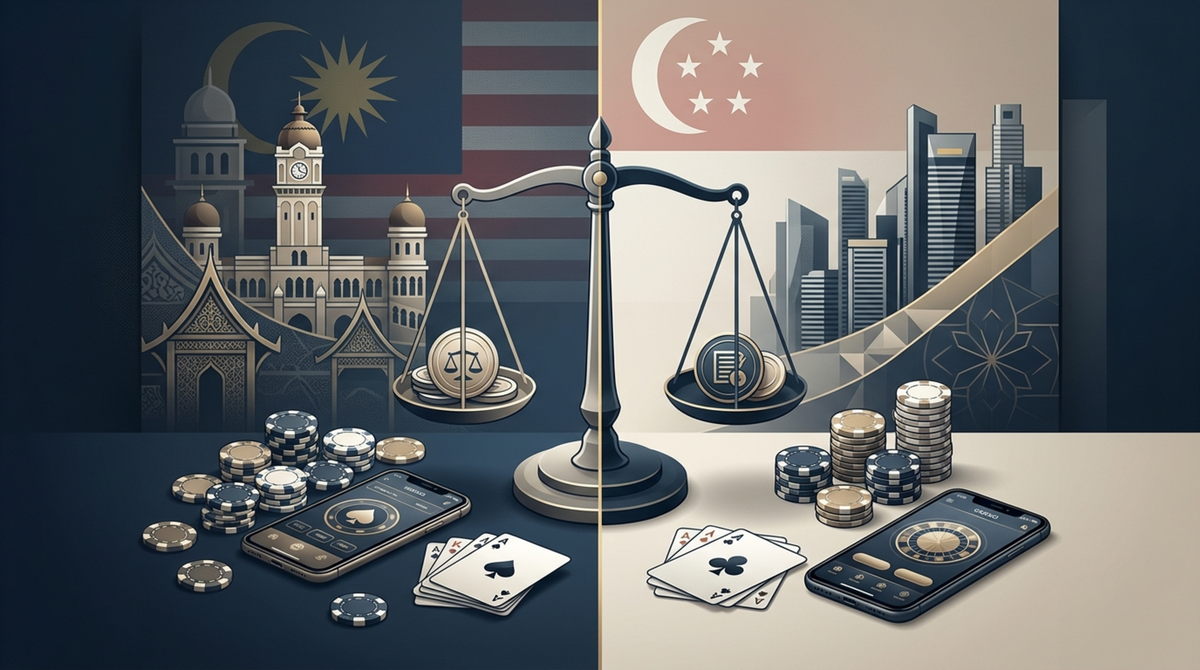
Malaysia and Singapore share a border, plenty of cultural ties, and a love for sports. But when it comes to gambling regulations, the two countries have taken quite different approaches. I think online gambling makes that difference especially easy to see.
Neither country gives online casinos a free hand to operate. But Singapore has built a modern system around one central regulator, specific gambling laws, and a very limited legal route for remote gambling. Malaysia still relies heavily on older gambling laws, alongside enforcement by several government bodies.
So, what does that actually mean for you as a player, operator, or just someone looking to comprehend the market for iGaming? I have done the research, and the difference is more significant than one might think at first.
Comparison of Their Gambling Laws
| Area | Malaysia | Singapore |
|---|---|---|
| Online Casino Market | No general licensing system for online casinos | No open commercial online casino market |
| Legal Remote Gambling | Highly restricted | Permitted through limited licensed services |
| Main Regulatory Structure | Several government authorities are involved | Centralised under the Gambling Regulatory Authority (GRA) |
| Online Enforcement | Website and content blocking, plus police action | Website, payment, and advertising blocking, plus police action |
| Religious Restrictions | Syariah restrictions also apply to Muslims | No religion-based gambling restrictions |
| Overall Approach | Older laws backed by active enforcement | Modern, centralised licensing and regulation |
The important point is that “restricted” does not mean exactly the same thing in both countries.
Malaysia Regulates Gambling Through an Older Framework
The laws on gambling in Malaysia were created at a time when it was impossible to access the casino website using a phone.
There are two laws in Malaysia which should be mentioned when talking about gambling: the Betting Act 1953 and the Common Gaming Houses Act 1953.
Although these laws predate online gambling, Malaysian courts have applied them to computer-based gambling activities.
In 2023, Malaysia’s Court of Appeal came to the conclusion that online gambling may be considered an offense within the meaning of the Common Gaming Houses Act 1953. The decision was related to the use of computers in online gambling.
That decision is important for players and operators because it makes the usual description of Malaysian online gambling as simply a “grey area” much harder to defend.
What Does This Mean for Online Casinos?
Gambling in Malaysia does have legal alternatives; however, this does not imply that Malaysia has a regular licensing process for online casino operators.
An offshore casino may be accessible from Malaysia and may even hold a licence somewhere else. Accessibility, however, is not the same as local authorisation.
We can see the government's position more clearly from its enforcement activity.
From January 2025 to May 2026, 457,562 pieces of online gambling-related content were taken down by service providers. During the same period, 1,778 gambling websites were blocked by internet service providers at the request of the MCMC.
The Royal Malaysian Police (PDRM) is also taking action against online gambling sites. For instance, in February 2026, 388 individuals were arrested by the police for being involved in a syndicate that was building online gambling facilities.
There is also another dimension to Malaysia’s policy. The predominant religion in Malaysia is Islam, and the Syariah laws also provide for more restrictions on gambling for the Muslim community. Thus, the gambling law in Malaysia cannot be regarded as a singular regulation acting in isolation.
Singapore Chose a More Centralised System
Cross over to Singapore, and the regulatory picture looks quite different.
The gambling regime in Singapore has been revised in 2022. The Gambling Regulatory Authority (GRA) has been set up on the basis of the former Casino Regulatory Authority and manages the gambling industry in the country.
The underlying idea behind this regulation is quite simple: gambling is illegal unless it is licensed or exempted.
Singapore does not try to deny that gambling exists. The government permits some gambling activities to be carried out under a strict control regime. The GRA manages higher-risk gambling services such as the casinos operating in the country and lottery and betting services provided by Singapore Pools.
The Gambling Control Act 2022 is one of the key laws in this system. Importantly for an iGaming audience, it also repealed the old Remote Gambling Act 2014 and brought remote gambling into the newer framework.
Singapore Pools Does Not Mean an Open iGaming Market.
This is where I think people can easily misunderstand Singapore. Yes, legal remote gambling exists. However, that does not imply that international online gambling sites could obtain a licence in Singapore and compete for customers.
At present, the only company allowed to engage in remote gambling under the license of the GRA is Singapore Pools. Engaging in unlicensed remote gambling in Singapore is illegal.
So Singapore has created a legal channel without creating an open iGaming market, and that is a big difference.
Online Gambling Shows the Difference Best
If we put the two countries side by side, we can clearly see the difference in how they approach gambling regulation.
Malaysia is dealing with modern online gambling largely through older gambling legislation, court interpretation, content blocking, and enforcement. Multiple authorities can become involved.
Singapore went another way. It consolidated much of its gambling framework under newer legislation and created the GRA as a central industry regulator.
Yet both countries arrive at a similar practical point for international online casino operators: neither should be treated like an open licensing jurisdiction.
There is an important lesson for players here. Just because you can access offshore gambling websites doesn’t necessarily mean it is legal to do so.
How Do They Deal With Offshore Gambling Sites?
You cannot regulate online gambling simply by putting a law on paper. The offshore companies may not even have an office physically located in that particular country, and a blocked website can often reappear under a new address.
Both governments know this.
Malaysia uses measures such as website blocking and content removal alongside police enforcement. MCMC even increased its monitoring of online gambling websites and promotional content during the 2026 FIFA World Cup.
Singapore combines several tools as well.
Since January 2025, the Singapore Police Force has been responsible for blocking access to unlawful remote gambling services, their advertisements and related payment transactions.
The scale is worth looking at. More than 3,800 illegal gambling sites and 145,000 illegal gambling transactions valued at S$37 million had been blocked in Singapore by the end of 2024. The government also openly acknowledged that blocking is not foolproof because illegal operators can simply create new websites.
I think that last point is concerning. Neither country has found a magic switch that makes offshore gambling disappear. Their systems are about making illegal operations harder to access, promote, and fund.
Player Protection Also Looks Different
Singapore puts harm reduction directly into its regulatory model.
The GRA has specified measures including pre-commitment programs, employee training to recognize problem gambling, and responsible gambling information and assistance for people showing signs of gambling-related harm. Advertising of gambling activities is not allowed unless approved by the regulatory body.
Malaysia's model feels different because prohibition and enforcement play a larger role, particularly around illegal online gambling. Religious restrictions add another dimension that Singapore does not have.
That does not mean one country “likes” gambling and the other does not. Both countries clearly see gambling as an activity that can create social and criminal risks. They only approach these risks from different angles.
What Does This Mean for iGaming Operators?
If you work in iGaming, the biggest mistake would be to group Malaysia and Singapore simply because both are restrictive markets.
Singapore has a clear central regulator and an expressly authorised remote gambling channel. But that channel is extremely narrow. Singapore Pools remains the only licensed remote gambling operator.
In June 2026, Singapore's Ministry of Home Affairs again stated that all other gambling operators, whether online or in person, are illegal unless otherwise authorised.
Malaysia presents a different challenge. The regulation is not as centralized; however, enforcement of its rules regarding online gambling is very serious.
It is not enough for operators to think about whether the site is technically available. Advertising, payment processing, local promotion and affiliate activity can all create separate compliance issues.
For players, the same rule of thumb is useful: an offshore licence does not automatically override the law where we live.
Are Malaysia or Singapore Moving Toward a More Open Online Gambling Market?
At the moment, there is little reason to assume either country is about to become a liberal online casino market. Singapore continues to update its regulatory and enforcement system while maintaining tight control over legal gambling.
Malaysia has also been moving toward stronger control rather than obvious liberalisation. However, in August 2026, its Ministry of Finance noted that there have been no new gambling licences or permits granted by the current administration since coming to power, and would continue to crack down on unlicensed and online gambling.
It goes without saying that gambling regulations may change over time. This is the reason why all operators, affiliates, and gamblers should be aware of present regulations rather than reading the outdated article.
Conclusion
Although Malaysia and Singapore may be neighbors, the regulation of gambling in each country is quite distinct.
Malaysia still relies heavily on its antiquated gambling laws, judgments from the courts, and enforcement by various agencies to regulate the online gambling market.
Singapore has built a more centralised framework around the Gambling Control Act and the GRA, while allowing a very limited form of licensed remote gambling.
Neither approach creates an open market for international online casinos. For me, that is the most interesting part of the comparison. The two countries share many of the same concerns about illegal gambling, crime, and social harm. They simply chose different regulatory routes to deal with them.
And if you are looking at either country from an iGaming perspective, that difference matters much more than whether an offshore casino website happens to load on your screen.
Sources
Ministry of Finance Malaysia (MOF) — Official statement on gambling activities, licensing, and enforcement in Malaysia. Ministry of Finance Malaysia — Gambling Regulation Statement
Gambling Regulatory Authority of Singapore (GRA) — Official guidance on unlawful remote gambling, licensed remote gambling services, and enforcement measures in Singapore. GRA — Unlawful Remote Gambling Activities
Bernama / Malaysian Communications and Multimedia Commission (MCMC) — Report citing the Communications Ministry on the removal of 457,562 pieces of online gambling-related content and blocking of 1,778 gambling websites from January 2025 to May 2026. Bernama — Online Gambling Content and Website Blocking Statistics