How Casino Bonuses Really Work: The Mathematics Behind Wagering Requirements
A $100 bonus at 35x means $3,500 of bets, and an expected loss bigger than the bonus. The maths of wagering requirements, game contributions and the terms that limit withdrawals.

You have probably seen online casinos offering a $100 welcome bonus and wondered whether it is really free money. If you deposit $100, can you withdraw $200? Almost certainly not. With a 35x wagering requirement, you might have to place thousands of dollars of bets before withdrawing any of it.
Casino bonuses come with conditions: wagering requirements, restricted games and withdrawal limits. By the time you have met them, there may be little or nothing left to withdraw. This article explains how wagering requirements work, how RTP affects a bonus's value, and the conditions that are easy to miss.
What happens when you claim a bonus?
Bonuses give players extra credit, free spins or other rewards, subject to conditions. A common one is the deposit match: "100% up to $100" means depositing $100 earns an extra $100 in bonus credit. Not all bonuses work the same way, though.
Deposit matches and bonus balances
Deposit $100 and receive a $100 bonus, and your account may show $200. But the casino may hold your cash and your bonus in separate balances with different rules, using one before the other or both together. The operator's terms decide how those funds are treated.
Bonus money vs withdrawable cash
A $200 balance does not mean you can withdraw $200. Your deposit and the bonus may have different withdrawal rules. Often the bonus cannot be withdrawn until wagering is complete; some offers convert the remaining bonus to cash once requirements are met. There is no single rule for every casino, which is why the balance shown can be far more than you can actually take out.
What are wagering requirements?
A wagering requirement is the total amount of qualifying bets you must place before you can withdraw bonus-related funds. It is also called playthrough or rollover, and is usually expressed as a multiple such as 10x, 20x or 35x. The higher the multiple, the more betting is required, assuming the same calculation base and game rules.
What does 35x mean?
Suppose you get a $100 bonus with a 35x requirement calculated on the bonus:
$100 × 35 = $3,500
You must place $3,500 of qualifying bets. That does not mean depositing $3,500, nor does the casino take $3,500 from you. It is the total of all your bets, including bets funded by earlier winnings. But every bet can lose, and you may run out of money before you reach the target.
How to calculate the wagering
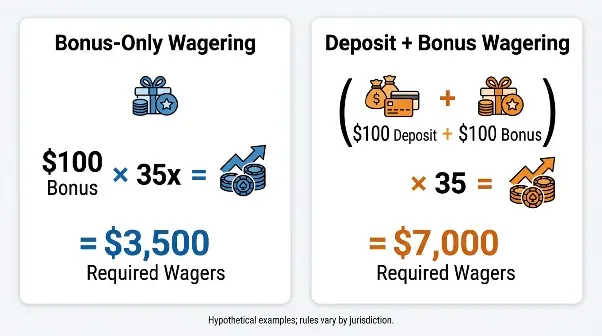
The multiple is usually easy to spot; the base it applies to is not. Some offers apply it to the bonus only, others to the deposit and bonus combined.
Bonus-only wagering
Deposit $100, get a $100 bonus with 35x bonus-only wagering: $100 × 35 = $3,500 of qualifying bets.
Deposit plus bonus wagering
The same offer calculated on deposit plus bonus: ($100 + $100) × 35 = $7,000. The bonus is still $100, but the required betting has doubled.
Why the base matters
| Wagering multiple | Bonus only ($100) | Deposit + bonus ($200) |
|---|---|---|
| 10x | $1,000 | $2,000 |
| 20x | $2,000 | $4,000 |
| 35x | $3,500 | $7,000 |
| 40x | $4,000 | $8,000 |
These are maths examples, not offers that are legal everywhere. People tend to compare promotions by the size of the bonus, but the wagering calculation can make a smaller-looking offer far less demanding than a bigger one. And the required betting is only part of the picture.
How RTP changes the maths
RTP, return to player, is how much a game is expected to pay back from all money wagered over time. A slot with 96% RTP has a theoretical house edge of 4%: over a long period it is designed to keep about 4% of the money bet. That matters when you work out the cost of clearing a bonus.
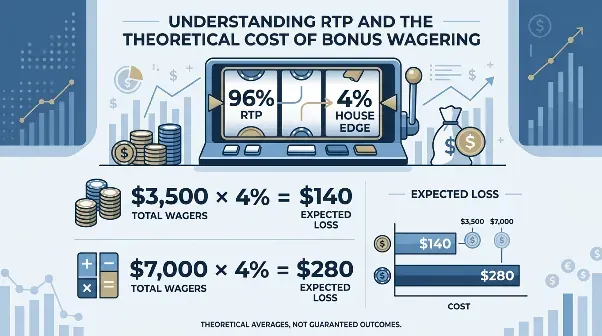
Expected losses while wagering
Take the $100 bonus with 35x bonus-only wagering: $3,500 of bets. On a 96% RTP slot:
Expected loss = total wagers × house edge = $3,500 × 4% = $140
If the 35x applies to deposit and bonus, the wagering becomes $7,000 and the expected loss $280.
These figures assume you complete all the wagering. In reality, one player may run out of money early while another finishes with money left. The figures do not predict what happens to any individual.
Is a $100 bonus worth it?
A $140 expected loss against a $100 bonus suggests the offer is worth minus $40. But that is incomplete. The real value also depends on whether you run out of money first, how the bonus converts to cash and any cap on winnings. A player who runs out after $500 of bets never reaches $3,500; another may finish with money to spare. As the UK Gambling Commission explains, actual RTP over any period can differ from the theoretical figure because games are volatile. Expected losses show the scale of a requirement, not your chance of completing it or what you will withdraw.
Why many players never clear their bonus
Running out first
A player with a $200 balance who needs $3,500 of bets does not have $3,500. Reaching the target depends on winnings being returned along the way. If the balance hits zero first, the promotion cannot be completed without depositing more, and the player may lose both their deposit and the bonus.
Volatility
Two games with the same 96% RTP can behave very differently. One pays small prizes often; the other pays big prizes rarely. The second is more volatile, which makes short sessions unpredictable: you might hit a big win early or suffer a long losing streak. Neither changes the long-run RTP.
Completing wagering is not making money
Placing $3,500 of qualifying bets only means the wagering condition is met. It says nothing about how much is left: $20, $150 or nothing. Other withdrawal restrictions may still apply.
How game contributions change the required bets
Not every game counts equally towards wagering. Bets on eligible slots might count in full, while only a fraction of table game bets count. A $10 bet on a game with a 20% contribution reduces the requirement by just $2, while the full $10 is at risk.
| Game contribution | Actual bets needed to clear $3,500 |
|---|---|
| 100% | $3,500 |
| 20% | $17,500 |
| 10% | $35,000 |
| 0% | Bets do not count |
These percentages are hypothetical; real terms vary and some games are excluded entirely. A lower contribution means more betting, and a game with high RTP is not automatically the best choice for a bonus once contribution rules are taken into account.
The terms that affect your withdrawal
The wagering multiple is the most visible condition, but not the only one.

Maximum bet rules
Some promotions cap the stake per bet while the bonus is active. A bet above the limit can break the terms even if the game accepts it.
Expiry dates
Many bonuses expire. If the wagering is not completed in time, the bonus money and any winnings from it may be lost. The deadline does not change the odds of the games.
Withdrawal caps
Some bonuses limit how much you can withdraw. You might win $500 from a bonus but only be allowed to cash out $200. Check the cap before you accept.
Restricted games and cancellation
Some games may not count towards wagering, and some may be banned during a promotion. Cancelling a bonus can also cost you the bonus credits and any winnings from them. Find out how much of your balance is real cash, and what happens if the promotion is cancelled, before treating the balance as your money.
A $100 bonus from start to finish
Putting it all together: a player deposits $100 and gets a $100 bonus with 35x bonus-only wagering, slots counting 100%, on a 96% RTP slot.
| Item | Hypothetical amount |
|---|---|
| Cash deposit | $100 |
| Bonus credit | $100 |
| Starting balance | $200 |
| Wagering requirement | 35x bonus |
| Required qualifying bets | $3,500 |
| Theoretical RTP | 96% |
| Expected loss on $3,500 of bets | $140 |
One possible outcome: the balance runs out before $3,500 is wagered, and the bonus is never completed. Another: the player reaches $3,500 with money left, and whether it can be withdrawn depends on the terms. A third: the player wins big, but a withdrawal cap means not all of it can be cashed out.
What this information cannot tell us is the player's exact chance of completing the bonus, or the offer's true expected value, without knowing the game's payout structure and how balances and withdrawals work. The $140 expected loss is a useful guide, nothing more.
Why do casinos set wagering requirements?
Bonuses are a marketing cost for casinos, not free cash. A generous welcome bonus can win a customer who would otherwise go elsewhere; free spins can keep existing players coming back. Wagering requirements stop players taking the bonus and withdrawing it straight away, and because most games have a house edge, the extra betting generates revenue for the operator.
That does not make every bonus profitable for casinos, and not every player loses. But very high wagering requirements can push players into longer and heavier gambling, which is why some regulators now restrict them.
Bonus rules differ by market
Bonus rules are not the same everywhere. A requirement in an older article or an offshore promotion may not be allowed for a licensed operator elsewhere.
The UK's 10x cap
From 19 January 2026, the UK Gambling Commission capped wagering requirements at 10x for operators it licenses, and banned promotions that mix different products, such as casino and sports betting. The Commission said high wagering requirements can confuse consumers and encourage people to gamble for longer or faster. The rules are set out in Social Responsibility Code 5.1.1. The 35x and 40x examples in this article are therefore illustrations only, not compliant offers from UK-licensed operators.
Why local law matters
Other jurisdictions have their own rules, and in some countries online gambling is not allowed at all. Malaysia has no licensing regime for online casinos, so an offshore site being reachable does not mean it may serve Malaysian players. A bonus offer says nothing about whether the gambling itself is legal.
How to read a bonus before claiming it
A big bonus means little until you know the conditions. Check:
- Calculation base: is wagering on the bonus alone, or deposit plus bonus?
- Multiple: how much qualifying betting is required?
- Game contributions: which games count, and by how much?
- Withdrawal conditions: what happens to bonus funds and winnings once wagering is done?
- Cash-out limits: is there a maximum withdrawal?
- Time and bet limits: when does it expire, and are some stakes or games excluded?
If the terms are unclear, the headline amount is not enough to judge the offer. And no bonus is a reason to keep gambling past your own spending limit.
Conclusion
Casino bonuses are advertised as extra money, but the maths often says otherwise. A $100 bonus at 35x can mean $3,500 of qualifying bets, and the calculation base and contribution rates can push that far higher. RTP helps you estimate what to expect, but it does not guarantee you will complete the requirement or have anything left. The key difference is between what a casino promises and the terms that decide whether you can use it. A bonus can look generous and be worth very little.
Frequently asked questions
What does 35x wagering mean on a $100 bonus?
If it is calculated on the $100 bonus alone, you must place $3,500 of qualifying bets. If it applies to deposit and bonus, the figure is higher.
Is a casino bonus free money?
Usually not. Most bonuses are promotional credit with wagering and withdrawal conditions, and the amount shown may not be withdrawable.
Can you withdraw your deposit before completing wagering?
It depends on the terms. Some operators let you withdraw your cash balance but cancel the bonus; others treat balances differently.
Does a higher RTP make a bonus profitable?
No. Higher RTP means a lower house edge, but a bonus's value also depends on contributions, caps and other conditions.
Are 40x wagering requirements still allowed in the UK?
No. Since 19 January 2026, UK-licensed operators are limited to 10x. Other countries set their own rules.
Sources
- UK Gambling Commission, Gambling promotions to be safer and simpler: the reasons for the wagering cap and other promotion rules.
- UK Gambling Commission, Social Responsibility Code 5.1.1: current rules on rewards, bonuses and the 10x limit.
- UK Gambling Commission, How to calculate RTP: theoretical and actual game returns.
- UK Gambling Commission, Live RTP performance monitoring: turnover, volatility and recycled winnings.