How Malaysia's Online Gambling Laws Actually Work: A Research-Based Guide
Malaysia has no licence for online casinos, but its 1950s gambling laws still apply online. How the Betting Act, the Common Gaming Houses Act, a 2023 court ruling and today's enforcement fit together.

In Malaysia it is easy to open an offshore gambling website, browse its games and sometimes even register an account. Does that mean the site operates legally? The answer depends on some peculiarities of Malaysia's gambling laws.
Malaysia has no licensing system for online casinos. Instead, it relies on legislation from the 1950s, court decisions and government enforcement. What makes the system unusual is that laws written for physical gambling are applied to activity that is entirely digital.
This guide looks at the legislation, the key court decision and recent enforcement, and the distinctions that players and operators should understand.
Is online gambling legal in Malaysia?
In one line: Malaysia does not permit anyone to run an online casino business for Malaysian players. That does not mean all gambling is illegal, though. Some licensed gambling is allowed, including lotteries, certain betting and the casino at Resorts World Genting, each under specific licences and conditions.
Online casinos are different. There is no Malaysian licensing process that lets an offshore online casino serve local players, and a gambling licence from another country makes no difference.
| Gambling activity | Legal position in Malaysia |
|---|---|
| Commercial online casinos | No domestic licensing framework |
| Offshore gambling websites | Foreign licences do not give Malaysian authorisation |
| Licensed land-based casino | Permitted under its licence conditions |
| Licensed lotteries and betting | Permitted within the scope of the licence |
| Unlicensed gambling operations | Subject to criminal enforcement |
| Gambling involving Muslims | Additional state Syariah laws apply |
The key point is that the legal position of a gambling business differs from that of a gambler. What exactly someone does, and where, matters.
The laws that govern gambling in Malaysia

Malaysia's gambling laws were never designed with online betting in mind. They date from a time of physical gaming houses, betting agents and paperwork. That does not make them irrelevant today, but it does make their interpretation especially important.
Betting Act 1953
The Betting Act 1953 deals with illegal betting, including betting houses and bookmaking. It is particularly relevant to organised betting rather than casino games. For online betting businesses, the question is whether the activity falls within the Act's offences, and placing bets electronically does not by itself take it outside the law.
Common Gaming Houses Act 1953
The Common Gaming Houses Act 1953 is central to the debate about online casino gambling. It deals with common gaming houses and sets out offences covering running gambling premises, gaming equipment and taking part in unlawful gaming. Although it dates from 1953, Malaysian courts have considered how it applies to computer-based gambling.
There is also a geographical detail: the Act applies to Peninsular Malaysia. Sabah and Sarawak have their own laws, which need to be considered separately.
Lotteries Act 1952 and licensed gambling
The Lotteries Act 1952 regulates lotteries, while other laws and licences govern specific gambling businesses. This is why licensed lottery outlets and certain betting operations can exist even though unlicensed gambling businesses are prosecuted. A licence for one activity, however, does not give an operator permission to offer others.
Syariah restrictions
Most Malaysians are Muslim, and religious law adds another layer. Muslims are subject to state Syariah criminal laws that prohibit gambling. These operate alongside federal law rather than replacing it, and they vary from state to state. Non-Muslims are not subject to Syariah criminal law. Gambling in Malaysia is therefore governed by more than one system.
How a 2023 court ruling changed the debate
For years, online gambling in Malaysia was often described as a legal grey area, on the assumption that laws written in the 1950s could not cover computer-based gambling.
A 2023 Court of Appeal ruling made that position very hard to defend. The case involved online gambling carried out on computers, and one question was whether the absence of traditional gaming machines took the activity outside the Common Gaming Houses Act 1953. The court rejected that narrow reading and confirmed that the relevant provisions could apply to computer-based online gambling operations, even though the Act was written long before internet casinos existed.
This is one of the most important developments in Malaysian gambling law: old legislation does not stop working simply because technology changes.
It has limits, though. The decision concerned how the Act applied to particular operations and premises. It did not settle every question about individual players using offshore websites. But the broader point is clear: it can no longer be argued convincingly that online gambling sits outside Malaysian law.
How Malaysia enforces online gambling restrictions
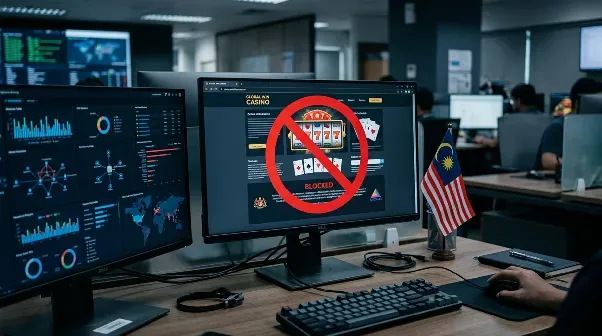
Having a law is one thing; identifying the people behind gambling websites, removing their ads and stopping their operations is another. The two key agencies are the Royal Malaysia Police (PDRM) and the Malaysian Communications and Multimedia Commission (MCMC).
Police investigations and raids
The police investigate gambling businesses run from premises in Malaysia, including those operating through computer-based gambling sites. Investigations can involve computers, financial records, phones and the people running the operation.
The 2023 Court of Appeal case is an example: it concerned gambling carried out from a house in Melaka using computers and laptops, and reached the appellate court because of questions about how existing law applied. Even when the gambling happens online, the people and equipment behind it can be investigated in the ordinary way.
Website blocking and content removal
Malaysia also targets the online visibility of gambling businesses. According to a parliamentary reply reported by Bernama in July 2026, 457,562 gambling items were removed from the internet between January 2025 and May 2026, and internet service providers blocked 1,778 gambling websites at the MCMC's request in the same period.
Those figures show that enforcement goes beyond arrests: the authorities are also trying to make gambling services harder to find and reach. Gambling businesses depend on more than a website. How they advertise, take payments and communicate with customers can all come under scrutiny. And because a blocked site can reappear at a new address, enforcement has to be continuous.
What legal risks do players and operators face?
A common mistake in discussions of Malaysian gambling law is to treat everyone involved as one group. Running a gambling business, promoting it and placing a bet are different activities, and the legal risks are not the same.
Individual players
Individuals who commit an offence under the gambling laws can be held liable. Section 6(1) of the Common Gaming Houses Act is one example, and it was relevant in the 2023 case to a person found gambling on a laptop. That does not mean everyone who uses an offshore gambling website commits the same offence; the location and the exact activity matter.
Operators
People who run unlawful gambling operations can be charged too. In the 2023 case, one defendant had been convicted of managing online gambling under Section 4B(a) of the Common Gaming Houses Act. The Court of Appeal upheld the conviction, which carried a prison sentence and fines. Penalties depend on the offence, so it would be wrong to assume one punishment applies to all gambling crimes.
Agents and promoters
Agents and promoters should not assume they are safe because they do not own the gambling website. Their activities can range from recruiting customers and placing bets to handling money and marketing. Whether that amounts to an offence depends on the specific law, and it is a real compliance issue for iGaming companies that rely on local promotion and affiliates.
Does an offshore licence make a site legal in Malaysia?
This is where offshore gambling companies often cause confusion. An online casino may hold a genuine licence from another country and display it on its website, and it may be properly authorised to operate under that country's law. But Malaysia is not required to recognise that permission. A foreign licence does not override Malaysian law or create a right to serve Malaysian customers.
There is also a difference between a site being accessible and being authorised. A website loading on your phone says very little about its legal position. Players who assume an offshore licence settles every legal question are mistaken.
Why Malaysia has not modernised its gambling laws
Malaysia's gambling laws were drafted long before smartphones, cryptocurrencies and international online casinos. That creates practical problems: a modern gambling site may be owned in one country, hosted in another and used by customers in many more, which sits awkwardly with laws built around physical premises.
It would be wrong to say the system has not adapted at all. Courts have applied existing laws to computer-based gambling, and enforcement agencies have found ways to tackle online advertising and communication. But interpretation and enforcement are not the same as new legislation.
There have been calls for reform. In 2023, the Home Ministry said it would push to amend outdated laws to fight online gambling. Proposals, however, should not be confused with laws that have actually been passed. For now, Malaysia relies on a combination of older statutes, court interpretation and administrative enforcement.
What changed in 2026?
Recent statements show the government is sticking with its restrictive approach and has no plans to allow an online casino industry.
According to the Ministry of Finance, on 27 August 2026 the MADANI government confirmed it had not issued any new gambling licences or permits since taking office at the end of 2022. The number of licensed gambling premises was unchanged, and all existing licences remained subject to conditions.
The government distinguished between regulating existing licensed gambling and acting against illegal gambling, and said it would strengthen enforcement against unlicensed and online operators. This was not a new law, but a restatement of the existing policy: licensed gambling only, and firm action against everyone else.
Conclusion
Malaysia's online gambling laws become easier to understand once you stop treating their age as proof that online gambling is unregulated. The Betting Act 1953 and the Common Gaming Houses Act 1953 remain central, and the courts have confirmed that they can apply to some forms of computer-based gambling.
Enforcement has also moved far beyond traditional raids. Website blocking, content removal and investigations into online operations are now a large part of the government's response. Some legal questions still need careful analysis, especially those involving offshore platforms, individual players and different state laws.
Whether you look at Malaysia as a player, an affiliate or an operator, the important question is not whether a gambling website is accessible. It is whether the activity behind it is permitted under the law that actually applies.
Sources
- Common Gaming Houses Act 1953 (Act 289): provisions on gaming houses, gaming machines and geographical scope. This consolidation notes that later amendments may not be included.
- Malay Mail / Bernama, Court of Appeal ruling, October 2023: details of the decision on online gambling operations.
- Bernama, Communications Ministry enforcement figures, July 2026: reported content removals and website blocking.
- Ministry of Finance Malaysia, gambling licensing statement, August 2026: the government's position on licences and enforcement.