RTP Explained: What Malaysian Players Should Understand Before Playing Casino Games
96% RTP does not mean you get RM96 back from RM100. What RTP really measures, how volatility and hit frequency differ, how to check a game's RTP, and what it says nothing about.

You have probably seen slot games showing "96% RTP". Does that mean you get RM96 back if you spend RM100? Not at all. You could lose the RM100 in a few spins, or end up with more than you started with.
RTP, or return to player, shows how much a casino game is expected to pay back over a very large number of bets, not in a single session. This article explains where the percentage comes from, why the same slot can have different RTPs and what Malaysian players should understand about it.
What does RTP mean?
RTP is the percentage of all money wagered on a game that the game is designed to pay back as winnings over the long run. A slot with 96% RTP is designed to pay back, on average, RM96 for every RM100 wagered.
It does not mean everyone gets the same result. One person may lose RM100 in half an hour while another wins RM500.
What 96% RTP means in practice
Imagine thousands of players together betting RM1 million on a 96% RTP game. In theory, the game would pay back about RM960,000, and the remaining RM40,000 would be the casino's expected gambling revenue before costs. But those figures come from the game's mathematics. The actual payouts could be higher or lower.
RTP vs house edge
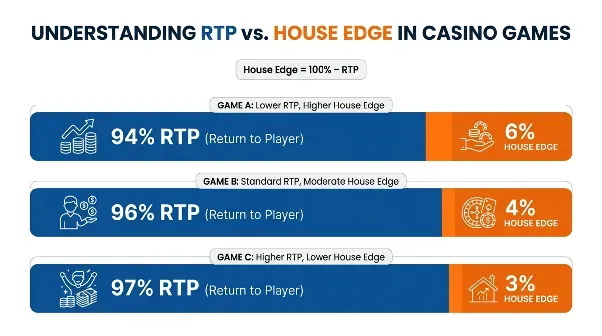
RTP and house edge are two sides of the same calculation:
House edge = 100% − RTP
- 94% RTP means a 6% theoretical house edge.
- 96% RTP means a 4% house edge.
- 97% RTP means a 3% house edge.
A higher RTP generally means a smaller mathematical disadvantage for the player, as long as the figures are accurate and comparable. But RTP says nothing about how often a game pays or how big individual payouts are.
How is RTP calculated?
There are two kinds of RTP. Theoretical RTP is calculated from a game's probabilities, rules and payouts. Actual RTP is measured from real betting and payout data:
Actual RTP = (total winnings ÷ total wagers) × 100
If a game takes RM500,000 in bets over a period and pays out RM475,000, its actual RTP is 95%. If it was designed for 96%, its measured return is one percentage point lower. That alone does not mean anything is wrong.
Theoretical vs actual RTP
The UK Gambling Commission's RTP monitoring guidance gives an example: a game designed for 91.68% RTP took £1.2 million in bets and paid back about £1.085 million, a measured RTP of 90.42%.
| Measure | Figure |
|---|---|
| Designed RTP | 91.68% |
| Total wagers | £1,200,000 |
| Total winnings | £1,085,000 |
| Actual RTP | 90.42% |
The regulator explains that volatility and the number of rounds played can make actual results differ from the theoretical figure. (This is a UK regulatory example, not data from Malaysian players.) Without knowing the sample size and the game's characteristics, a gap between actual and theoretical RTP is hard to interpret.
Why RTP does not predict your winnings
Some people see 97% RTP and think they have a 97% chance of winning. They do not. RTP is about how much money comes back on average, not what share of spins win. A game can return much of its money through occasional big prizes while most spins pay nothing.
RTP is not a session guarantee
Say you bet RM2 a spin on a 96% RTP game. After 20 spins your RM100 might be down to RM60, while another player hits a big win in five spins. The 96% does not mean your balance will settle at any particular level, and your whole deposit can disappear without anything like RM96 coming back.
Can a slot be "due" a win?
You may hear that a slot is ready to pay because it has not produced a big win in a while. For games with independent random outcomes, that is wrong. If the odds are the same every round, past losses do not make a win more likely next time. This mistake is known as the gambler's fallacy. Some games do carry features over between rounds, such as collected symbols or bonus meters, but those are explained by the game's rules. A losing streak does not mean a big win is coming.
RTP, volatility and hit frequency
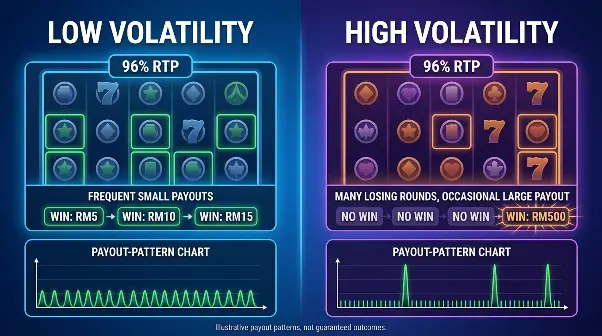
Two games with the same 96% RTP can feel completely different to play. One pays small prizes often; the other goes long stretches without much, then pays out big. Volatility explains much of the difference.
High vs low volatility
Volatility describes how unpredictable a game's results are. In a low-volatility game, returns come in smaller, more frequent amounts. In a high-volatility game, more of the return comes from occasional big wins.
| Feature | Slot A | Slot B |
|---|---|---|
| Theoretical RTP | 96% | 96% |
| Volatility | Lower | Higher |
| Typical payout pattern | Smaller, more frequent returns | Larger, less frequent returns |
| Guaranteed session result | None | None |
Both have the same expected return, but the experience differs greatly. A high-volatility game can drain a balance quickly even when its RTP looks favourable.
Hit frequency is something else
Hit frequency is how often a game produces a winning result. A game might "win" on 30% of spins, but that is not its RTP, and many of those wins may pay less than the stake. Bet RM2 and win RM1, and the game counts a win while your balance falls. RTP, volatility and hit frequency answer different questions; looking at only one gives an incomplete picture.
Why a RM100 deposit can mean much more betting
Deposits and total bets are not the same. A player deposits RM100, wins some spins and keeps betting with the winnings. Over time, they may wager RM1,000 having deposited only RM100.
On a 96% RTP slot, the house edge is 4%:
RM1,000 × 4% = RM40 expected loss
That assumes the player actually wagers the full RM1,000. Some will run out much sooner; others may finish ahead. If the player wagers RM1,000 from the original RM100 with no other deposits or withdrawals, the expected balance is RM60, though the real result could be very different. That is why RTP calculations are based on total wagers, not the original deposit.
Do all casino games have the same RTP?
No. Each game has its own mathematics, and even versions of the same game can differ. Roulette shows this clearly: European roulette has 37 pockets with a single zero, while American roulette has 38 with both a zero and a double zero. With standard payouts, the extra pocket raises the house edge.
| Game | Theoretical RTP | House edge |
|---|---|---|
| European roulette | 97.30% | 2.70% |
| American roulette | 94.74% | 5.26% |
| Baccarat, banker bet | About 98.94% | About 1.06% |
| Blackjack | Around 99.5% with favourable rules | Around 0.5% |
| Online slots | Varies by game and setting | Varies |
The blackjack figure assumes favourable rules and correct basic strategy; it does not apply to every table or player.
Slots and roulette
In roulette, the expected return comes from the wheel's design and the payout for each bet. Slots are different: their RTP depends on the game's mathematical setup, including how often symbols appear and what they pay. A slot's published RTP applies to a specific configuration of that game, not to every slot from the same provider.
Blackjack and baccarat
In blackjack, player decisions affect the expected return, as do the number of decks, the dealer's rules and the payout for a natural blackjack. In baccarat, the banker bet is simpler, but the usual 5% commission shapes its return. A single RTP figure for "blackjack" or "baccarat" can be misleading; the reasons behind the number matter as much as the number.
Can the same slot have different RTPs?
Yes. Many slots are released with several mathematical configurations, so one casino may offer a higher-RTP version and another a lower one.
| Configuration | RTP | House edge |
|---|---|---|
| Version A | 96% | 4% |
| Version B | 94% | 6% |
Both could share the same name, look and features. Over RM10,000 of bets, the theoretical expected loss is RM400 for Version A and RM600 for Version B, a difference of RM200. That does not mean a player will lose more on Version B in any one session, but the two have different mathematical expectations.
Why the version matters
A review site may say a slot has 96% RTP while a particular casino runs a different configuration, or the review may be out of date. The figure shown inside the game itself matters more than a general number found online. If a game does not clearly state its RTP, there may not be enough information to verify any figure advertised for it.
How to check a game's RTP

An RTP figure is only useful if there is good reason to trust it. Many websites publish long tables of slot RTPs without saying which version they refer to. It is better to check the game's own information.
Find the game's RTP
Look in the game's help section, rules, paytable or information page for "return to player", "theoretical RTP" or "expected return". In the UK, the Gambling Commission's technical standard RTS 3 requires licensed operators to give players information about game outcomes and the likelihood of winning before they play, which can include RTP, house edge or probabilities. That is a UK licensing requirement; there is no guarantee that sites reachable from Malaysia follow it.
Check the provider and version
If a casino names the game developer, you can compare its information with the provider's official documentation where available. The game title alone may not reveal the RTP setting. Check, too, whether the figure includes bonus features or jackpots. If sources contradict each other, do not rely on the highest number.
Know what testing certificates prove
Testing labs examine casino software, but certificates cover different things. iTech Labs, for example, distinguishes between RNG certification, RNG and game certification, and audits of live RNG and RTP performance. An RNG certificate covers the system that generates random results, not necessarily the game's payouts. Game testing can check rules and payout structures; operational audits compare recorded results with expected performance. Treat a testing logo as a claim to check, not a complete guarantee, and remember that certifying a game is not the same as legal authorisation for the casino offering it.
Does a higher RTP mean a better game?
A higher RTP means a lower theoretical house edge, as long as the figures are accurate and comparable.
| RTP | House edge | Expected loss on RM1,000 wagered |
|---|---|---|
| 94% | 6% | RM60 |
| 96% | 4% | RM40 |
| 97% | 3% | RM30 |
Over the same amount of betting, the differences are clear. But it would be wrong to conclude that the 97% slot will pay more in your next ten spins. A player can hit a big win quickly on a lower-RTP game and get little from a higher-RTP one. A higher RTP means you are expected to lose more slowly over a long period; it does not protect you from losing your whole stake.
What about progressive jackpots?
Progressive jackpot slots add a complication. Part of the game's RTP may come from the jackpot, which grows with every qualifying bet, and depending on the game, the published RTP may already include the jackpot's expected contribution. If a large share of a slot's theoretical return comes from an extremely rare jackpot, most players will never see that part of the return in a normal session. RTP alone cannot show how winnings are distributed. The UK Gambling Commission's testing strategy covers how progressive jackpots are verified.
What Malaysian players should know about RTP claims
Most explanations of RTP focus only on the maths. For Malaysians, something important is missing: a site can display RTP figures, testing logos and international games without any licence to offer gambling in Malaysia.
RTP does not make a site legal
Malaysia's gambling laws are strict. In October 2023, the Court of Appeal ruled that online gambling operations can fall under the Common Gaming Houses Act 1953 even without physical gaming machines, as reported by Malay Mail. The ruling concerned how online gambling operations are classified under Malaysian law and left some questions about players and other activities open.
The key point for readers is that a gambling website being reachable in Malaysia does not mean it operates legally there. A foreign gambling licence or an RNG certificate does not make it legal for Malaysian players.
Be careful with unverified percentages
Gambling sites often make claims such as "99% winning rate", "hot slot today" or "guaranteed payout". These are not the same as a game's official RTP. If a site says a slot is paying more today, ask how that was measured: it might reflect a few lucky players, marketing or figures that cannot be checked. Even if true, it does not make a big win more likely in future. RTP describes long-term average returns; it never means a slot is likely to give your money back.
What to check before playing
- Published RTP: where does the figure come from, the game's rules or just a promotional site?
- Game version: does the published RTP apply to the version you are playing?
- Volatility and payouts: a high RTP says nothing about losing streaks, how often you win or how much.
- Testing information: understand what a certificate actually covers.
- Legality: a foreign licence does not make online gambling legal in Malaysia.
- Your limits: never treat gambling as a way to make money.
A high RTP lowers the theoretical house edge, but it does not mean playing on will win back earlier losses.
Conclusion
96% RTP does not mean you spend RM100 and keep RM96. It is the share of all stakes a game is expected to return over a very large amount of play. Individual results vary enormously, and a game's volatility, rules and configuration all affect how the percentage should be read.
For Malaysian players, where an RTP figure comes from matters as much as the figure itself. An RTP number on a gambling website is not proof of payouts, independent verification or official approval. RTP helps explain the maths of gambling; it cannot predict your wins or losses.
Frequently asked questions
What does 96% RTP mean?
In theory, the game pays back RM96 for every RM100 wagered across all players over the long run. It does not mean any individual gets RM96 back from a RM100 deposit.
Is a 97% RTP game guaranteed to pay more than a 94% one?
No. 97% means a smaller theoretical house edge, but results vary from session to session, and the lower-RTP game may pay more in any given session.
Can a casino change a slot's RTP?
Some slots come in several RTP configurations, and the version an operator offers may differ from the one described elsewhere. Any changes depend on the game's technical setup and applicable regulations.
Does RTP reset after a big win?
RTP is not a balance that resets. For games with independent random outcomes, a big win does not mean the game must pay less next.
Is RTP the same as the chance of winning?
No. RTP measures the expected share of money returned. The chance of winning is the probability of particular outcomes, and hit frequency is how often winning results occur.
Does a certified RTP mean an online casino is legal in Malaysia?
No. Game testing and RTP certification are technical matters. They do not show that a casino is authorised to offer gambling to Malaysians.
Sources
- UK Gambling Commission, Live return to player performance monitoring: theoretical and actual RTP, volatility, sample size and the regulator's worked example.
- UK Gambling Commission, RTS 3: Rules, game descriptions and the likelihood of winning: disclosure of game rules, RTP, house edge and winning probabilities.
- UK Gambling Commission, Testing strategy for remote gambling software: game mathematics, independent testing and progressive jackpots.
- iTech Labs, Testing and certification: RNG certification versus game certification and operational RTP audits.
- Malay Mail, Court of Appeal ruling on online gambling: Malaysian interpretation of the Common Gaming Houses Act 1953.